
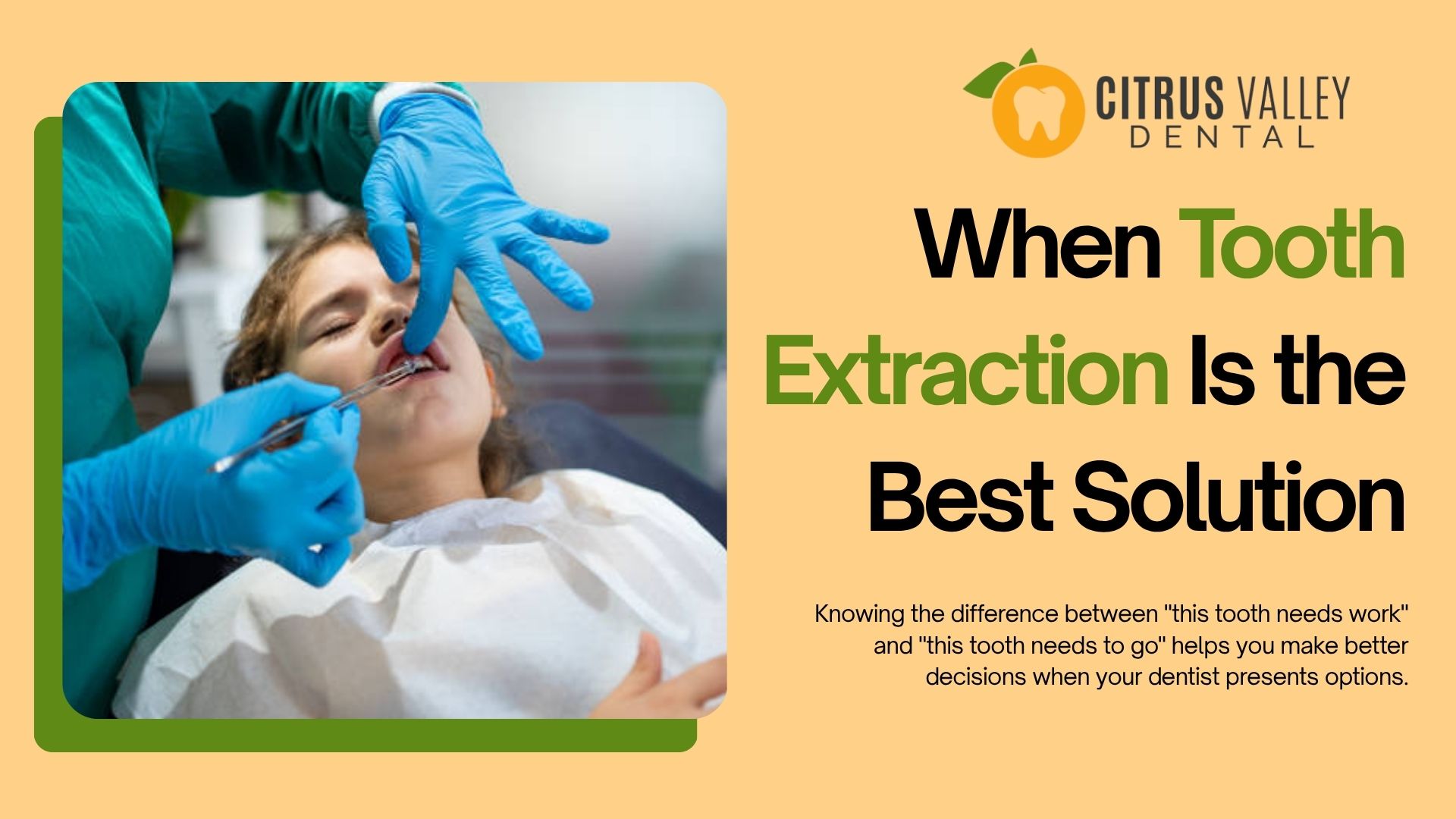
Most people leave the dentist hoping to walk out with the same number of teeth they came in with. That’s usually how it goes. But sometimes removing a tooth is genuinely the right call—not a sign of failure, not something that could have been avoided with better brushing, just the clinical reality of a tooth that’s past saving.
Knowing the difference between “this tooth needs work” and “this tooth needs to go” helps you make better decisions when your dentist presents options.
The Default: Save First, Extract Second
Dentists don’t reach for extraction lightly. Removing a tooth is permanent. Once it’s gone, neighboring teeth shift into the space, your bite changes, and you’re looking at either an implant, a bridge, or a gap indefinitely. That’s why dentists default toward fillings, root canals, and crowns before considering removal.
But preservation has limits. Some teeth are too structurally compromised, too infected, or too poorly positioned for any restoration to hold. In those cases, keeping the tooth creates more problems than removing teeth would solve.
Tooth Extraction Reasons: When Removal Makes Sense
Severe Decay
Decay that’s eaten into the pulp — the inner chamber containing the tooth’s nerves and blood vessels — usually calls for a root canal first. But if the decay has destroyed too much of the tooth’s structure, there’s nothing left to restore. A crown needs solid walls to grip. If those walls are gone or fractured down to the root, crowning it just delays an extraction that was always coming, and sometimes makes the eventual teeth removel harder.
Infection That Won’t Respond to Treatment
An abscess forms when bacteria reach the pulp and the infection spreads toward the root or surrounding bone. Root canal treatment is usually the first attempt — it drains the infection and removes the damaged tissue. But if the infection keeps returning, or if it’s already spread into the jawbone, tooth extraction stops the source.
This matters more than people realize. An ongoing oral infection isn’t contained to your mouth. For patients with diabetes, heart conditions, or compromised immune systems, persistent dental infections carry real systemic risk.
Advanced Gum Disease
Periodontal disease attacks the bone and connective tissue that anchor teeth in place. Early stages are manageable. Late stages are not. When enough bone is lost, the tooth loosens — and a loose tooth with deep infection around it is actively spreading bacteria into the surrounding gum tissue.
Extracting it, followed by treatment of the affected area, is often what stabilizes everything else. Leaving it in place doesn’t save the tooth; it just prolongs the infection. Teeth removing a tooth in this condition protects the ones next to it.
Overcrowding and Orthodontic Prep
Sometimes healthy teeth get extracted. Orthodontists often recommend removing one or more teeth before fitting braces when there isn’t enough room for proper alignment. The teeth coming out aren’t damaged — they’re just in the way of a better outcome for the whole mouth.
This is a planned, strategic decision. The goal is to create space so the remaining teeth align correctly and stay that way.
Impacted Teeth
An impacted tooth is one that’s stuck — blocked by another tooth, growing at an angle, or partially embedded in the jawbone. Wisdom teeth are the most common example, but canines and premolars can also be impacted.
Impacted teeth cause pressure and pain, push neighboring teeth out of position, and create pockets where bacteria accumulate. The longer they stay, the more damage they tend to do. Early removal, before complications develop, is almost always the cleaner option.
Cracked or Split Teeth
A crack that runs below the gumline or through the root usually can’t be sealed reliably. Bacteria get in through the fracture, and no filling or crown addresses the underlying gap. Not every cracked tooth needs extraction — your dentist will assess how deep the crack goes. But a root that’s split lengthwise is almost always a reason for teeth removing.
Tooth 16 Extraction: Why This One Comes Up So Often
Tooth 16 extraction is one of the more common procedures in adult dentistry, and patients are often caught off guard by it. Tooth 16 is the upper-left second molar — the large molar sitting just before the wisdom tooth on the upper left side.
A few things make this tooth particularly vulnerable.
It’s hard to clean properly. Positioned at the back of the upper jaw, tooth 16 is difficult to reach with a toothbrush or floss. Decay and gum disease accumulate there without pain or obvious symptoms until the damage is already significant.
Root canal treatment here is complex. Upper molars have three or four roots, and tooth 16’s anatomy is notoriously variable. The procedure is technically demanding, and in severe cases, the success rate drops enough that extraction becomes the more predictable outcome.
The wisdom tooth behind it causes problems. If tooth 17 — the upper-left wisdom tooth — is present and poorly angled, it continuously pushes food and bacteria into the space around tooth 16. A restored tooth 16 can keep reinfecting if the wisdom tooth driving the problem stays in place.
The cost-benefit math doesn’t always favor restoration. A molar root canal plus crown is a significant expense. For a tooth that’s already heavily compromised, already difficult to maintain, and sitting in an area with limited long-term prognosis, some patients — reasonably — decide that tooth 16 extraction followed by an implant is the more durable plan.
One thing worth knowing: the upper molars sit close to the sinus cavity. Your dentist will take X-rays to assess root proximity before proceeding. It’s routine, but it does affect the technique used.
What to Expect During the Procedure
This is the part most people dread more than they need to.
Simple extraction applies to teeth that are visible and accessible above the gumline. The area is numbed with local anesthetic, the dentist loosens the tooth with an instrument called an elevator, and then removes it. The whole thing usually takes 10–20 minutes. You’ll feel pressure — not pain.
Surgical extraction is for impacted teeth, broken teeth, or roots that have fused to bone. A small incision is made in the gum, and the dentist may need to section the tooth or remove a small amount of surrounding bone. It takes longer and produces more post-procedure swelling, but it’s still done under local anesthetic and is a routine procedure.
After the Extraction: The Part That Actually Goes Wrong
The procedure is rarely the hard part. Most complications happen during recovery — and most are preventable.
Protect the clot. A blood clot forms in the empty socket within a few hours. It’s the foundation for healing. Sucking through a straw, smoking, spitting forcefully, or rinsing aggressively can pull it out. Without the clot, you get dry socket — exposed bone, significant pain, and a setback of several days. No suction for at least 48 hours.
Swelling peaks around day 2–3. Ice in the first 24 hours reduces it. Warm compresses after 48 hours can help. Most swelling clears within a week.
Pain should improve daily. If it gets worse on day 3 or 4, that signals dry socket or infection. Call your dentist — don’t wait it out.
Eat soft food, but eat. Skipping meals doesn’t help healing. Yogurt, eggs, and mashed potatoes work well. Avoid the extraction side. Avoid crunchy or small-particle foods like rice or seeds that lodge in the socket.
The Actual Bottom Line
Why teeth need to be extracted usually comes down to one of three things: the tooth is too damaged to restore, it’s actively spreading infection, or its position is causing harm to everything around it.
The decision isn’t whether saving the tooth is technically possible. It’s whether saving it is worth it — given the cost, the long-term prognosis, and what happens to the surrounding teeth if you leave it in.
Your dentist can walk you through that calculation. Going in with a clear picture of the tooth extraction reasons behind the recommendation helps you ask the right questions and make a decision you won’t second-guess.